

Dear Diary... A day in the life of a baby born with anal stenosis
This is the story of Josh, told by his mum Kate, whose name has been changed for privacy.

Josh was born in France to an Australian mum and a French dad. They moved back to Australia after the birth to be close to family. When Josh was born, he didn’t start to poo his meconium for over 7 days which is a red flag for healthy bowel function in babies (they should start pooing within 24-48 hours). He has since experienced severe constipation and had to have surgical treatment. This is his story, told by his mum Kate.
NAME: Josh
FAMILY: Two sisters, living in a bilingual house with French and English spoken at home
OCCUPATION: Primary school student
CONDITION: Anal stenosis
CURRENT TREATMENT: Osmolax, Botox injections and occupational therapy *names changed for privacy
The early days...
Josh didn’t pass any poo for the first week after he was born. The doctors were concerned and told me to keep an eye on it. Eventually he started having small spirts of meconium in his nappy (the first tar-coloured poo that babies pass when they are born). By day 13 he was still just passing little bits in each nappy and he was so uncomfortable and crying and screaming all the time. We took him back to the hospital and the doctors had to use their fingers to manually remove the poo. At this point we were told he had anal stenosis, which is not very common. It is a tightening of the muscles inside the anus which make passing poo very difficult because the muscles can't make space for the poo to come out.
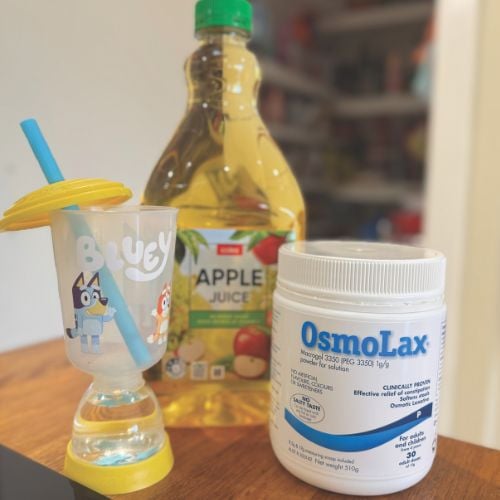
We had follow-up appointments after that and the doctors asked us to do manual dilation twice a week for the first six months which involved us inserting a finger into his anus to stretch the muscles to try and improve his ability to pass bowel motions. I am not sure if it helped or not, he was always constipated from the very start. Always type 1-2 on the Bristol Stool Chart. It was normally little pebbles of different coloured poo, or very thin strings of poo. When we were in France we were giving him Lansoyl oral jelly from about 3 months old which lubricated the poo making it easier to pass. When we came back to Australia our doctor told us about Osmolax (a type of laxative), which helps draw water into the bowel to make the poo more of the long thin sausage which is easy to pass, rather than hard little rocks which hurt when they come out. It took a few tries, but when we found the right dose it worked well and we kept adjusting the dose as he started solid food.
Treatment...
We were eventually referred to a special constipation clinic. The paediatrician we saw there suggested Botox injections into the anus and rectum muscles which would be done under general anaesthetic. As he explained it, the Botox allows some muscles to relax and others to activate, which can hopefully lead to better muscle coordination to poo more easily and more regularly. Josh was 3 when he had his first round of Botox. We had to give a lot of Osmolax to make the poo runny and he lost all control of his bowel so we put him back in nappies. He couldn't hold poos or farts and had to re-learn to control them, it took a while before he stopped having accidents. He would have a lot of urgency and not have a lot of warning before he needed to do a poo. Like cosmetic Botox, it takes about 2 weeks to be at its peak, but it made a huge difference in the diameter of the poos he was able to pass. He was no longer getting impacted and passing extremely large poos that were painful. We started treatment with an occupational therapist who worked with him on toilet posture, and helped the whole family get into a good routine of sitting on the toilet at the same time each day after breakfast and dinner to get into the habit of trying to do a poo. She taught him breathing techniques to poo without straining. We were very consistent with the toilet sitting and the Osmolax, which I think made all the difference. We eventually lessened the Osmolax and tried to control it with diet. With the Botox and the occupational therapy help, we had a really good 6-8 months before it started to get bad again. He had a second round of Botox at age 4, and they found inside he had fissures, scar tissue and haemorrhoids as well as an anal tag that has been cut off twice and keeps coming back. He got tested for Hirschsprung's disease with a biopsy during the Botox treatment and had to have an MRI to make sure there were no malformations higher up the digestive system.
"I USUALLY MIX THE OSMOLAX WITH A SMALL AMOUNT OF APPLE JUICE IN A FANCY CUP TO MAKE SURE HE DRINKS IT ALL."
Explaining consent...
Josh doesn't remember the manual dilation that we had to do when he was born, but on our first visit to the paediatrician when he was 3, the doctor did a rectal exam. This meant putting a finger up his bum to assess the stenosis. We had to talk about it a lot afterwards because usually we say anywhere under your undies is a private part and no one should touch it or look at it. It was really hard to explain that sometimes in the hospital we have to have things that we don’t like done to our bodies and it doesn’t feel safe. It's not nice, but we know that we need to do it to help the doctors know how to heal our body. We explained that it is only ok for a doctor to do that to you when they have asked you beforehand and your parents are with you. We were referred to a psychologist through the bowel clinic to help with his anxiety from all the medical treatments and appointments. It took a long time but it did help.
 Maintenance...
Now at age 6, Josh is no longer taking Osmolax or having Botox injections and we are able to manage his constipation with diet. We are still consistently doing toilet time once in the afternoon when we get home from school. We got into a great routine and he has started to manage it a bit more himself.
Advice to others...
With bowel problems and constipation you just have to do the work. You have to stick to the routine that the healthcare providers give you for months or years to maintain good results. Ultimately, managing constipation is a lifelong commitment. We did the hard yard—so much time sitting on the toilet floor keeping him company to get him into good habits of trying to poo regularly. I remember reading endless books and singing songs to keep him entertained. But it was worth it, we gave him the tools to keep healthy for life.